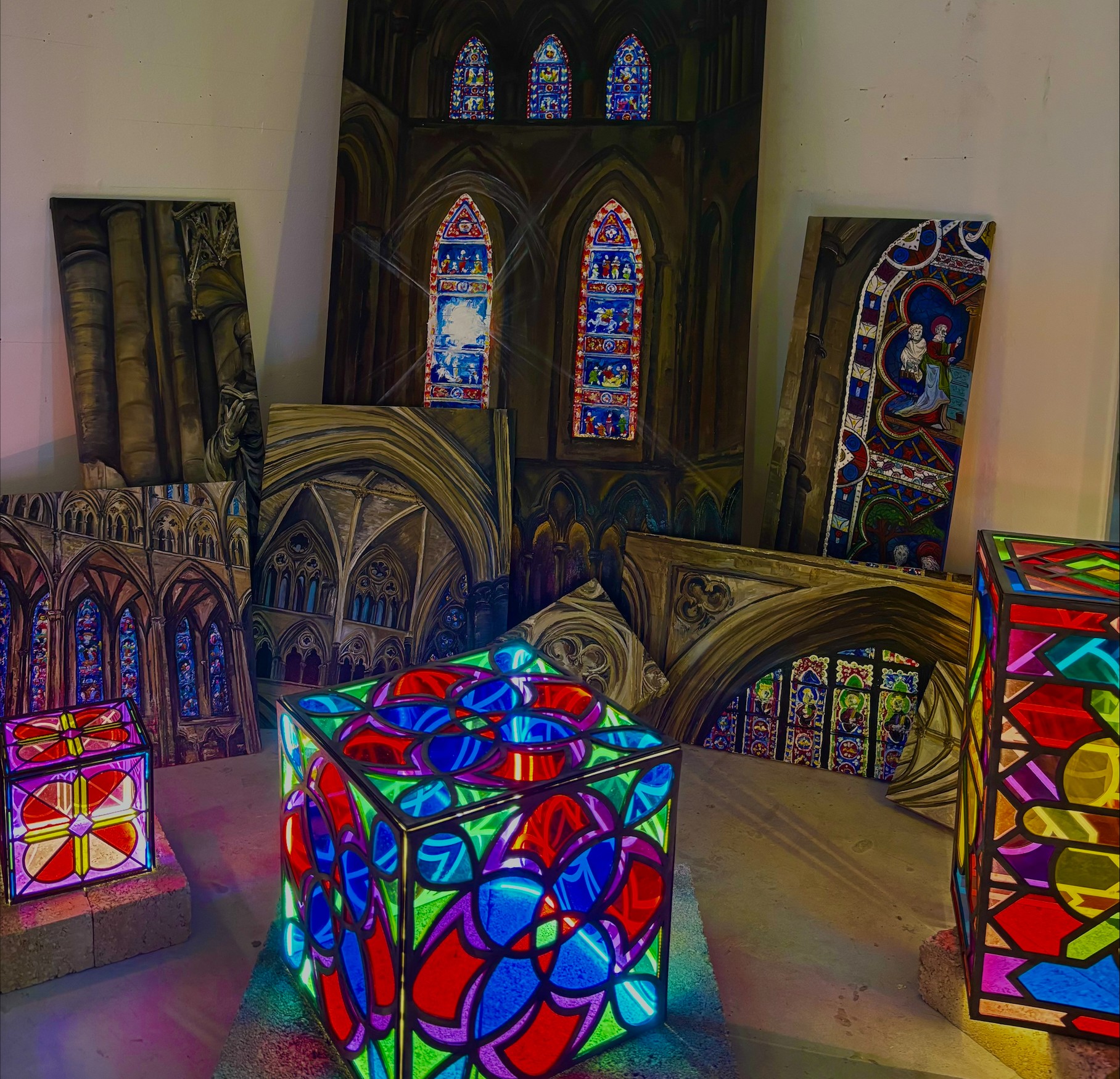
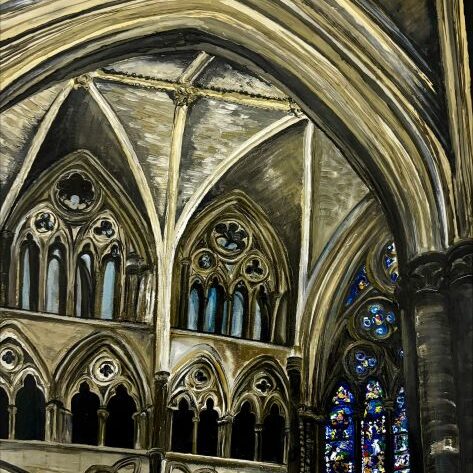
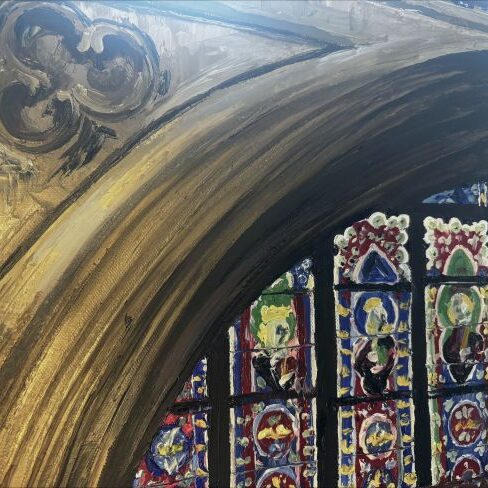
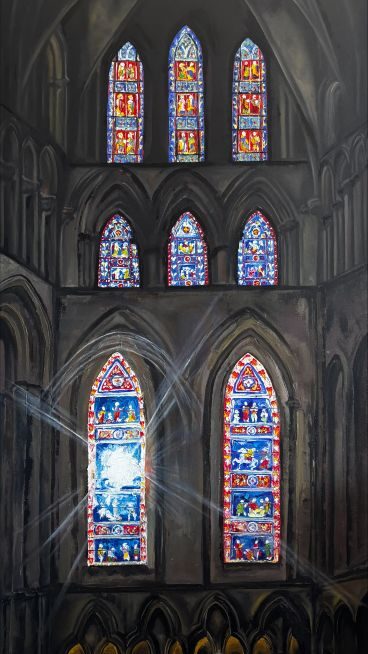
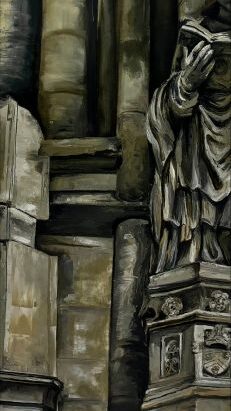
I am a multidisciplinary artist, specialising in oil painting. My work explores themes of craftsmanship through Gothic architecture, focusing on cathedral interiors to highlight detail, scale, and imperfection as a rejection of industrialisation.
Degree Show Work
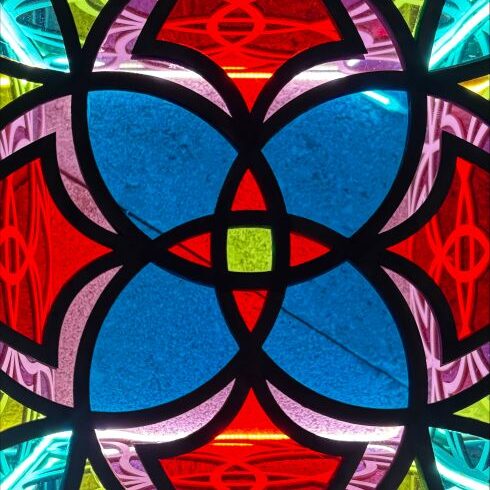
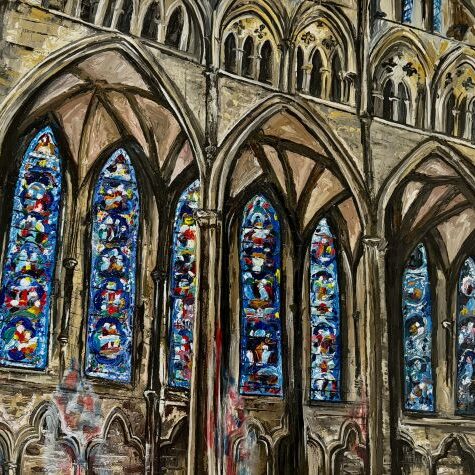
40.6cm x 50.8cm, Oil paint on canvas Polycarbonate Gel Lighting and Mountboard
A Closer Look
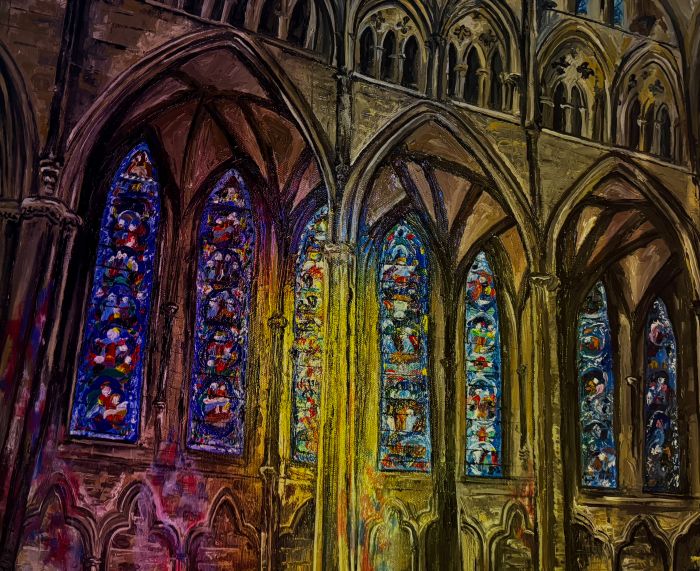
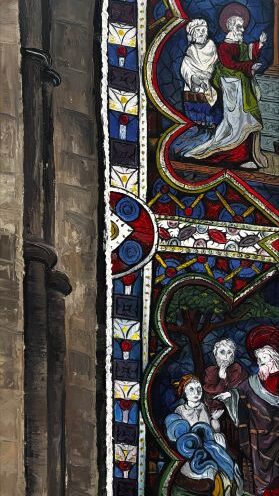
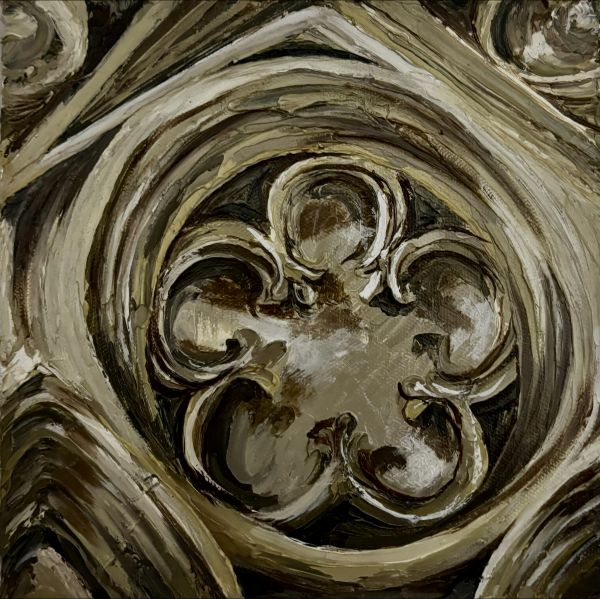
My paintings focus on the relationship between monumental scale and intricate detail, reflecting how vast cathedral interiors are composed through accumulations of small, highly worked elements. This attention to detail aligns with John Ruskin’s conception of Gothic architecture as a living and expressive form, in which irregularity and imperfection reveal the presence of the human hand. Rather than reproducing architectural precision, I adopt a painterly and impressionistic approach that translates ornamental complexity into gesture, colour and rhythm. Rigid structure gives way to variation and movement, allowing moments of instability and inconsistency to emerge as expressive qualities. In this sense, the work resists the mechanical uniformity associated with industrialisation, instead foregrounding the value of labour, touch and individual craftsmanship.
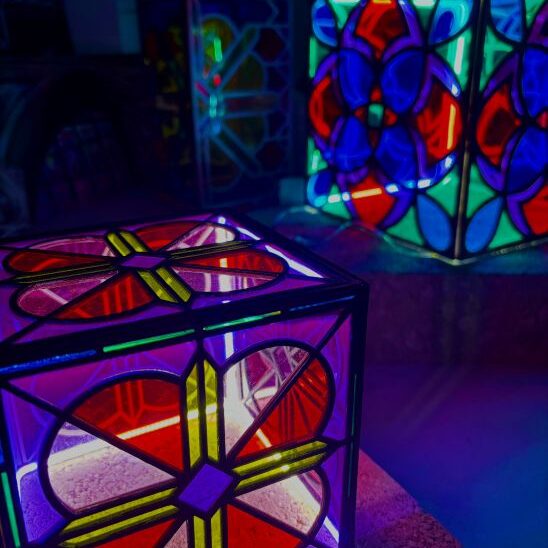
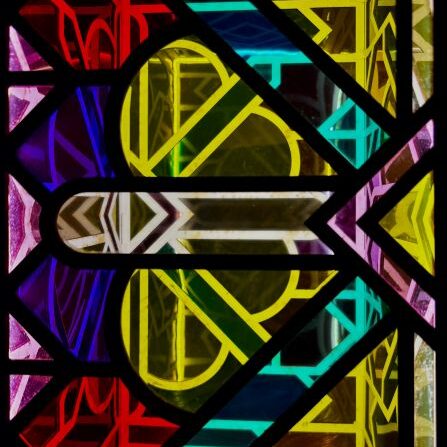
Material processes play a central role in extending these concerns into space. Laser-cut mountboard and polycarbonate gel lighting are used to construct layered light boxes that reinterpret the visual language of stained glass while emphasising the tension between handmade sensibility and industrial materials. The careful construction of these forms recalls the disciplined geometry and craftsmanship of traditional leadwork, while the translucent gels produce saturated colour and depth that emulate the luminous effects of stained glass. As light passes through these materials, it casts muted patterns across painted surfaces and the surrounding environment, continually transforming the work. This interplay between light, material and surface creates an environment in which the paintings are not fixed images but contingent experiences shaped by perception and presence.
Individual Works
50.8cm x 40.6cm, Oil on Canvas 31.75cm x 81.2cm, Oil on Canvas 198.12cm x 71.12cm, Oil on Canvas
21cm x 21cm, Polycarbonate Gel and Mountboard 27cm x 27cm, Polycarbonate Gel and Mountboard 81.2cm x 31.75cm, Oil on Canvas
40.6cm x 50.8cm, Oil on Canvas 21.59cm x 21.59cm, Oil on Canvas 81.2cm x 31.75cm, Oil on Canvas